Tidal Glass
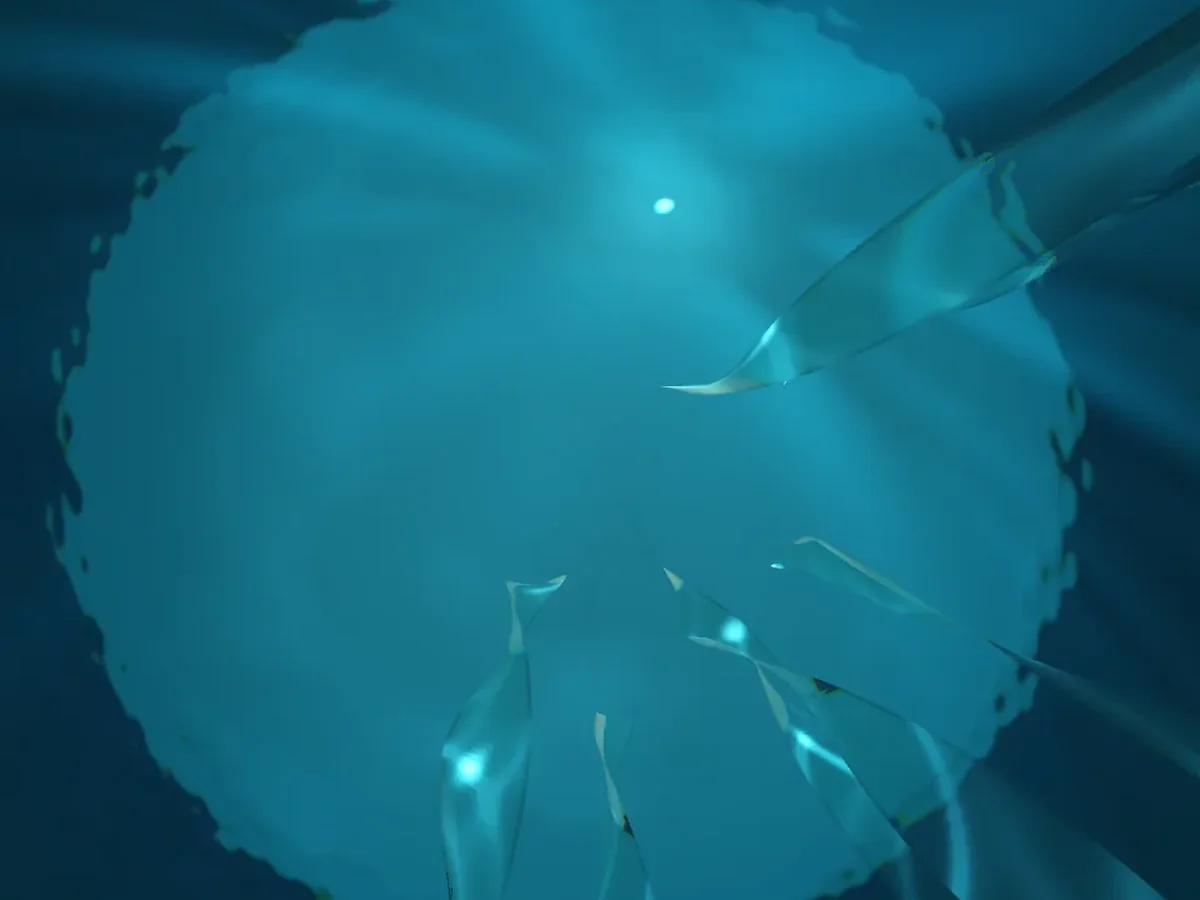
N° 0022An underwater scene that rises through the surface as you scroll.
A folded map opens into a landscape of routes and contours.
38 KB of text that builds one HTML file. Paste it into Claude Code, Cursor or v0 to rebuild this page.
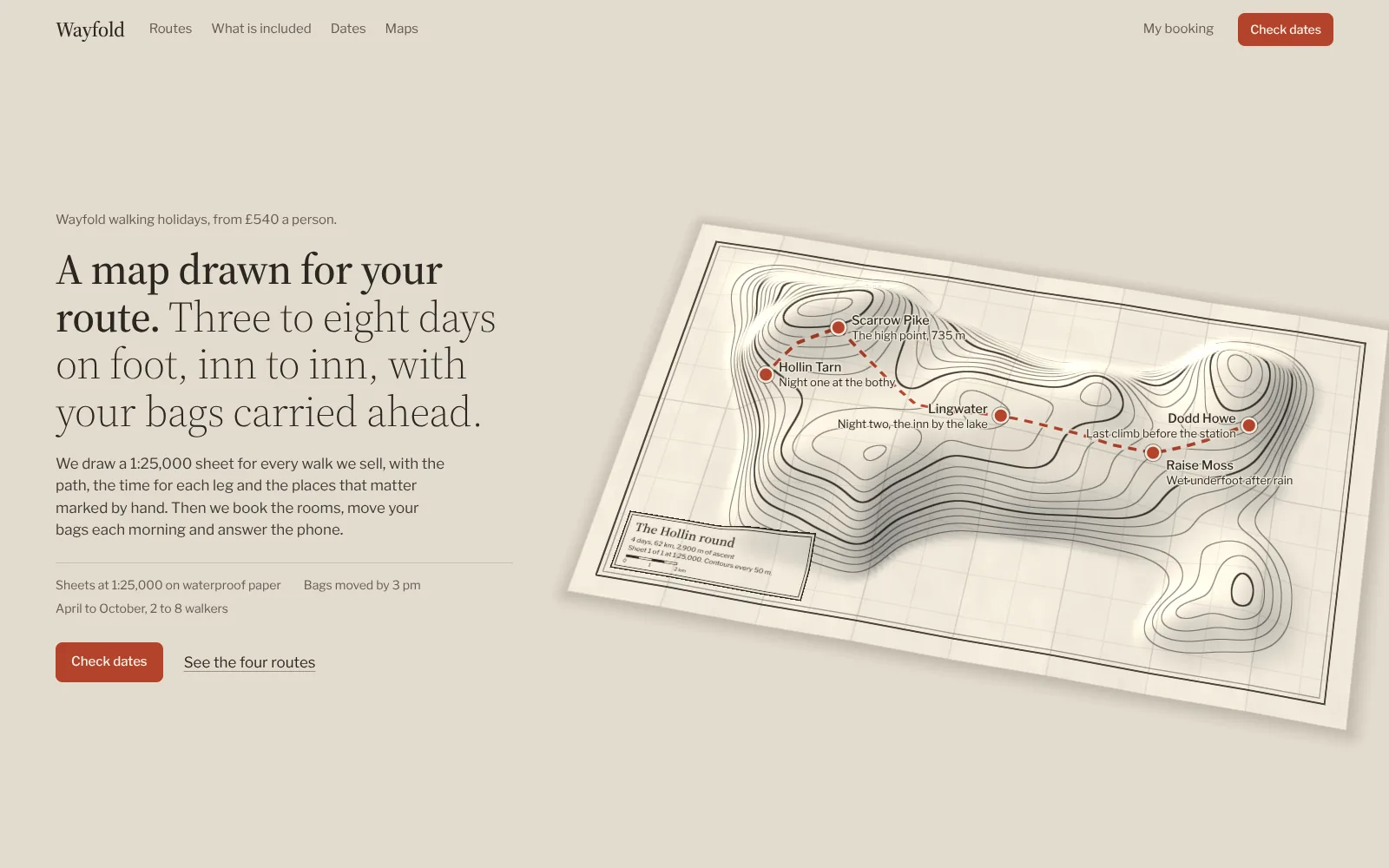
A folded walking map lies closed on the desk; scrolling opens it on hinged, curling folds, panel by panel, then fells rise out of the paper with their contour lines spreading from the summits, the route is inked across the tops and pins drop onto it with a soft bounce.
Signature momentThe open sheet in raking light: fells risen out of the paper, 1 px ink contours across them, the red route inked over the tops, pins standing on it with their place names and the title block printed in the corner.
A 10 by 6.25 sheet cut into 4 to 12 panels opens as a real roll fold: each crease hinges at its own height so the closed panels stack, and the free edge lags and curls as it turns. Scroll 3% to 42% opens it, panel by panel.
Once open the sheet keeps its folds: a shallow zigzag and darker crease lines that the creaseMemory knob turns up or down, so it reads as paper that was folded, not a flat plane.
From 42% to 76% of the scroll a seeded heightfield rises out of the sheet, up to 820 m on the map's scale, with hillshade from a warm key light at the upper left.
Contour lines come from the height in the shader with screen space antialiasing, every fourth one heavier, at an interval you set from 5 to 60 m.
A red route is inked across the tops from 75% to 92%, through seven waypoints that pass the high point. Pins with place names drop onto it over 420 ms as the ink reaches them, then the title block prints in the corner.
The renderer runs in a worker, draws only when something changed, and starts open on phones with no table shadows. Nine looks from Field and Blueprint to Night map.
DUSKLAYER.set()| Control | Key | Range | Default |
|---|---|---|---|
| Fold panels (the concertina, 4 to 12) | folds | 4 to 12 | 8 |
| Fold pace (higher turns each panel faster, with more overlap) | foldSpeed | 0.5 to 2 | 1 |
| Crease memory (how much the open sheet keeps its folds) | creaseMemory | 0 to 1 | 0.5 |
| Relief (1 puts the high point near 820 m) | relief | 0.3 to 2 | 1 |
| Contour interval in metres | contourSpacing | 10 to 120 | 50 |
| Hillshade (how strongly the slopes take the light) | hillshade | 0 to 1 | 0.6 |
| Key light warmth | lightWarmth | 0 to 1 | 0.55 |
| Paper fibre (texture in the sheet itself) | fibre | 0 to 1 | 0.5 |
| Paper | paperTone | color | #F2EBDC |
| Ink (contours, grid, type on the sheet) | inkColor | color | #2C2722 |
| Accent (route, pins, buttons) | accent | color | #B4432B |
| Page tone (the table under the sheet) | pageTone | select: light, dark | light |
| Route on the sheet (place names and title) | route | select: hollin, scarrow, lingwater, coast | hollin |
| Pins (0 to 6) | markerCount | 0 to 6 | 5 |
| Seed (terrain and route) | seed | 1 to 999 | 3 |
Something wrong with this layer? Report a problem and we fix it in the next version.
One text file, 38 KB, 10 sections. Every number the page uses is in it, so another model can rebuild the layer without seeing this one.
# Paper Atlas: build prompt

## Role
You are a senior creative front-end developer. Build one self-contained `index.html`: the home page of {{BRAND_NAME}}, which sells self guided walking holidays and draws a 1:25,000 map for every route. The hero is raw WebGL2: a folded paper map lies closed on a desk, cover up; scrolling opens the half fold, then the concertina panel by panel on hinged, curling folds; fells rise out of the flat sheet while 1 px ink contours spread from the summits, the route is inked in the accent and pins drop onto it with a 420 ms soft bounce, and a title block appears printed in the corner. Below: four routes with prices and distances, what is included, dates with a booking card, a four group footer. No Three.js, no framework. It must read as a real company's site.

## Output contract
- One `index.html`, no build step: HTML, CSS, eight GLSL script tags, one ES module, no image assets (the route sheets below the fold are drawn at runtime from the same terrain).
- Import map: `"lenis": "https://cdn.jsdelivr.net/npm/lenis@1.3.27/dist/lenis.mjs"`, loaded with `import('lenis')` after the scene boots (`lerp: 0.1, autoRaf: false`, driven from the page loop), never under `?capture=1` or reduced motion.
- Fonts: one Google Fonts link after two preconnects, non-blocking (`media="print" onload="this.media='all'"`, plus `noscript`): `{{FONT_DISPLAY}}:opsz,wght@8..60,300;8..60,500` and `{{FONT_BODY}}:wght@400;500`, `display=swap`. Serif text uses `font-variation-settings: 'opsz' 48`. Metric matched fallbacks, one `@font-face` per local font and weight, `line-gap-override: 0%`, all chained in the stacks. Serif 300 / 500: `local('Georgia')` size-adjust 94% / 95.2%, ascent 110.3% / 108.8%, descent 35.7% / 35.2%; `local('DejaVu Serif')` 80.9% / 82%, 128% / 126.4%, 41.4% / 40.9%; `local('Liberation Serif')` 102.8% / 104.2%, 100.7% / 99.4%, 32.6% / 32.1%. Body 400 / 500: `local('Arial')` and `local('Liberation Sans')` 103.4% / 104.4%, 93.4% / 92.5%, 23.8% / 23.6%; `local('DejaVu Sans')` 90.7% / 91.6%, 106.5% / 105.5%, 27.1% / 26.9%. Measures in em, never ch.

[35,136 more characters. Copy the prompt to get all of it.]An underwater scene that rises through the surface as you scroll.
Chrome lettering breaks apart under soft studio light, one letter at a time as you scroll.
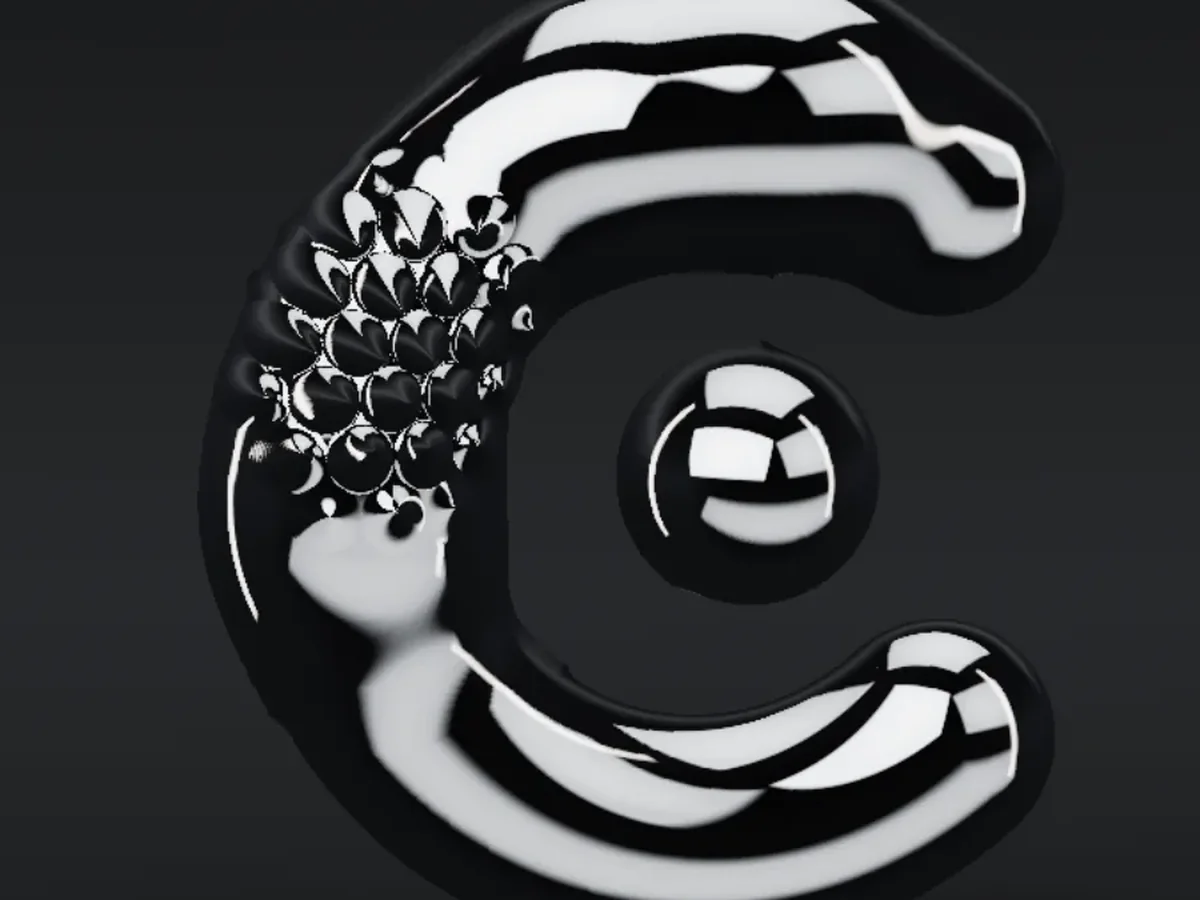
A chrome C forms from liquid metal, bristles into ferrofluid spikes near your cursor and slumps into a pool on scroll.