Quote Constellation
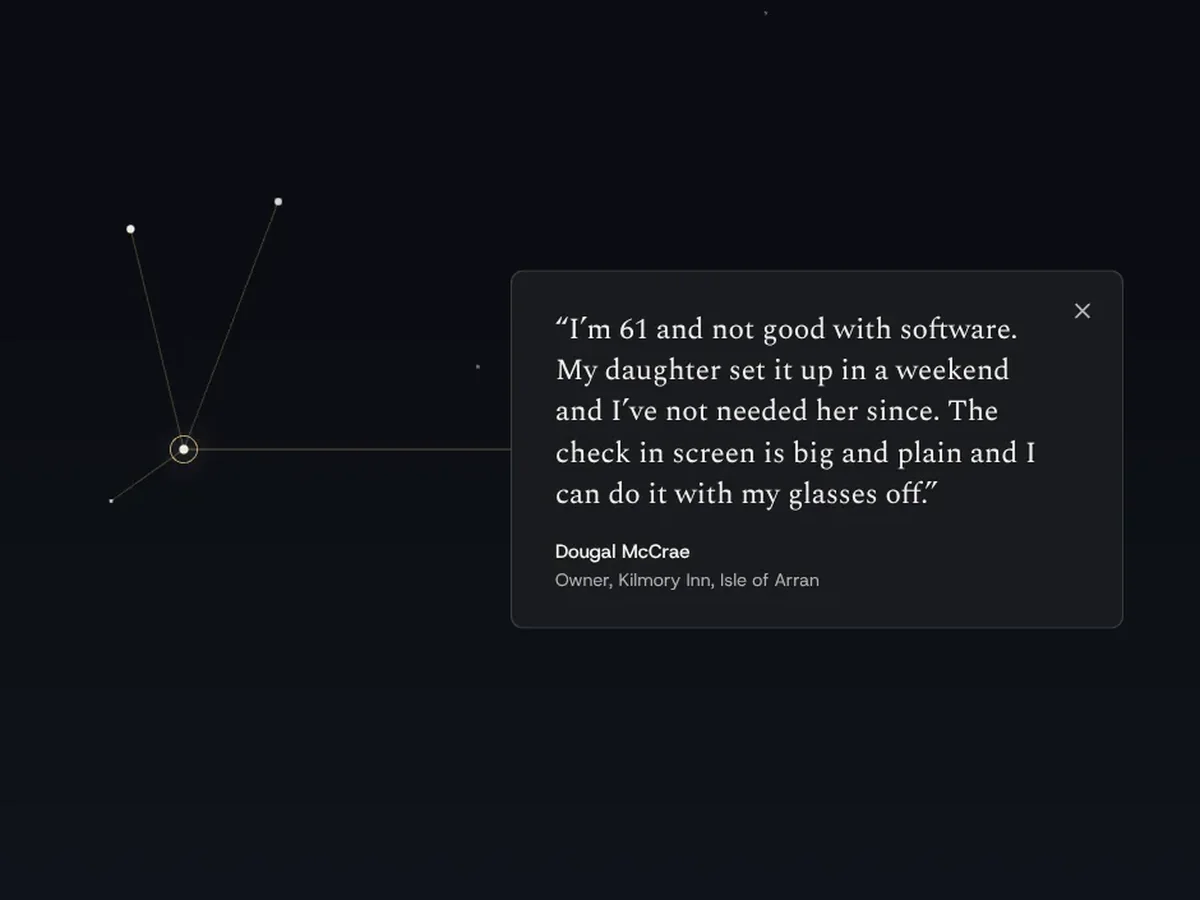
N° 0009Ten customer quotes shine as stars. Point at one for a line, or click and the camera flies in to open it.
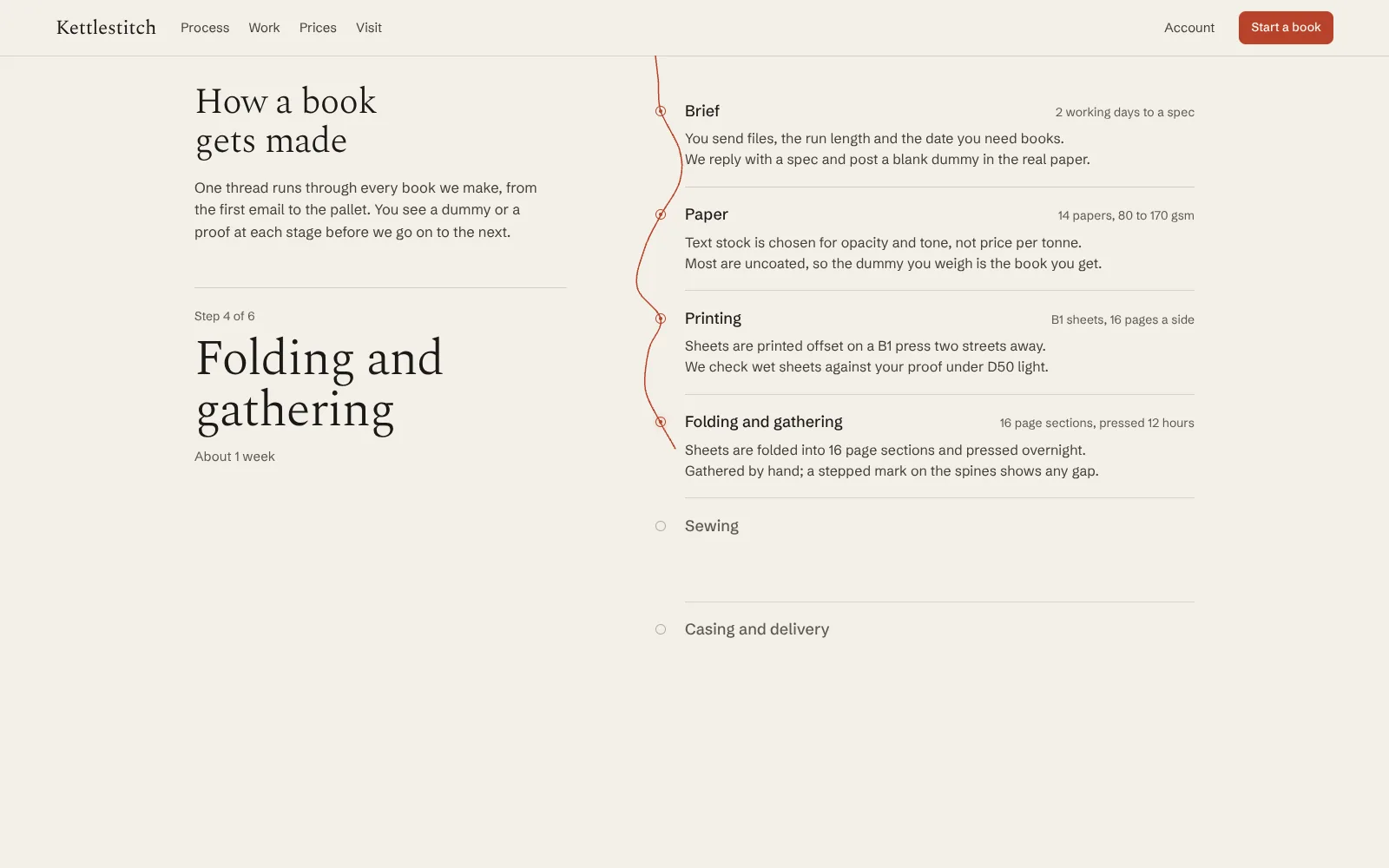
A hand drawn thread sews itself down through the process steps as you scroll, and each node flares like a struck match.
34 KB of text that builds one HTML file. Paste it into Claude Code, Cursor or v0 to rebuild this page.
A sticky four to six step process for an invented bindery: one hand drawn thread sews itself down through the step nodes as you scroll, each node ignites like a struck match when the thread reaches it, and that step's card reveals line by line.
Signature momentThe thread arriving at the fourth node: the match flare lifts off the ring while the step's two lines and its fact settle in beside it.
One SVG path, 1.5 px, through every step node: a Catmull-Rom spline over seeded waypoints with 15 to 30 px swings and a tension that drifts per segment, so it reads as a hand and not a plotter. Nine seeds, nine different threads.
stroke-dasharray draws it from 3% to 93% of a sticky section that is one viewport per step plus one. The thread chases the scroll with a lag you set (drawLag 0 to 1), so a fast scroll leaves it sewing for a beat.
When the thread passes a hole the node ignites: a 5.5 px core pops in 60 ms, a flame shaped halo lifts 7 px and fades over 420 ms, one spark rises 16 px, then a 1 px ring with a dot stays lit. flareIntensity 0 to 1.5.
Each step card is two sentences and a fact. They arrive 70 ms apart (40 to 120), each over 400 ms on an ease out expo, and leave in 160 ms if you scroll back up.
steps rebuilds the rows, the section height and the thread; the page copy for six bindery steps is in the DOM and the label reads Step 4 of 6 in plain words. On phones the band stays and the rows slide under it.
Linen, Night Shift, Unbleached, Indigo, Graphite, Oxblood, Chalk, Moss and Quarto change page tone, thread colour, step count, spacing and flare. One HTML file, no images, no canvas, Lenis the only library.
DUSKLAYER.set()| Control | Key | Range | Default |
|---|---|---|---|
| Steps | steps | 4 to 6 | 6 |
| Thread colour | threadColor | color | #B8432B |
| Thread width (px) | threadWidth | 1 to 2.5 | 1.5 |
| Flare intensity | flareIntensity | 0 to 1.5 | 1 |
| Thread swing between holes | swing | 0 to 1 | 0.7 |
| Hand wobble | wobble | 0 to 1 | 0.6 |
| Seed | seed | 1 to 9999 | 7 |
| Thread lag behind the scroll | drawLag | 0 to 1 | 0.45 |
| Line stagger (ms) | revealStagger | 40 to 120 | 70 |
| Row spacing | spacing | 0.8 to 1.6 | 1.4 |
| Node size (px) | nodeSize | 8 to 16 | 12 |
| Page | page | color | #F3EFE7 |
| Ink | ink | color | #1B1917 |
| Accent (buttons) | accent | color | #B8432B |
Something wrong with this layer? Report a problem and we fix it in the next version.
One text file, 34 KB, 10 sections. Every number the page uses is in it, so another model can rebuild the layer without seeing this one.
# Thread Process: build prompt

## Role
You are a senior creative front-end developer. Build one self-contained `index.html`: the website of {{BRAND_NAME}}, an invented bindery in {{BRAND_PLACE}} that prints, folds, sews and cases books for publishers, museums and studios. The centrepiece is a sticky process section. One hand drawn thread (a single SVG path, 1.5 px) sews itself down through four to six step nodes as the visitor scrolls. When the thread reaches a node the node ignites like a struck match (a hot core, a flame shaped halo that lifts and fades in 420 ms, one spark) and settles to a 1 px ring with a dot, while that step's card reveals line by line (400 ms ease out expo per line, 70 ms apart). The left column holds the section heading and the current step's title; the right column holds the step rows. Around it, the page a real bindery would publish: a header, a short text hero, a commissions table with real looking numbers, a start a book band with prices and lead times, and a four group footer. Pure DOM, SVG and `requestAnimationFrame`; no canvas, no WebGL, no library except Lenis for smooth scroll. It must read as a company's site, not a demo.

## Output contract
- One file `index.html`, no build step, no framework: plain HTML, CSS in one `<style>`, and one `<script type="module">`. Under 120 KB; no images.
- Import map with one exact version: `"lenis": "https://cdn.jsdelivr.net/npm/lenis@1.3.27/dist/lenis.mjs"`. Load it with `import('lenis')` after first paint (`new Lenis({ lerp: 0.1, smoothWheel: true, autoRaf: false })`, driven by your own rAF with `lenis.raf(now)`); ignore failures; skip it entirely under `?capture=1` and reduced motion. Until it resolves, read `scrollY`.
- Fonts: preconnect to `fonts.googleapis.com` and `fonts.gstatic.com`, then one Google Fonts link, non-blocking (`media="print" onload="this.media='all'"`, a `<noscript>` copy), `display=swap`: `{{FONT_DISPLAY}}:wght@300;400;500` and `{{FONT_BODY}}:wght@400;500`. Two metric matched local fallbacks so copy does not reflow when the webfonts land:

[31,058 more characters. Copy the prompt to get all of it.]Ten customer quotes shine as stars. Point at one for a line, or click and the camera flies in to open it.
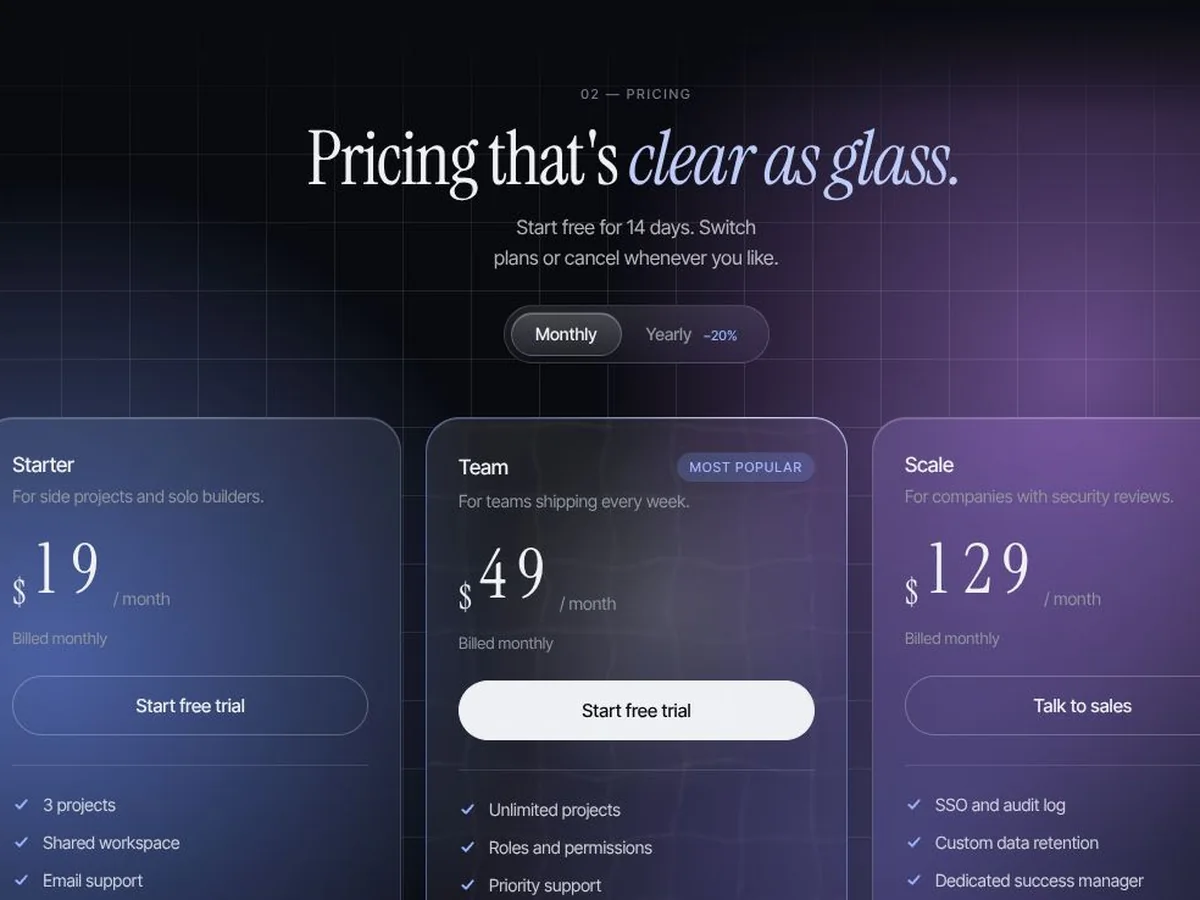
Three glass pricing cards turn liquid under your cursor. Switch to yearly and every digit rolls like an odometer.
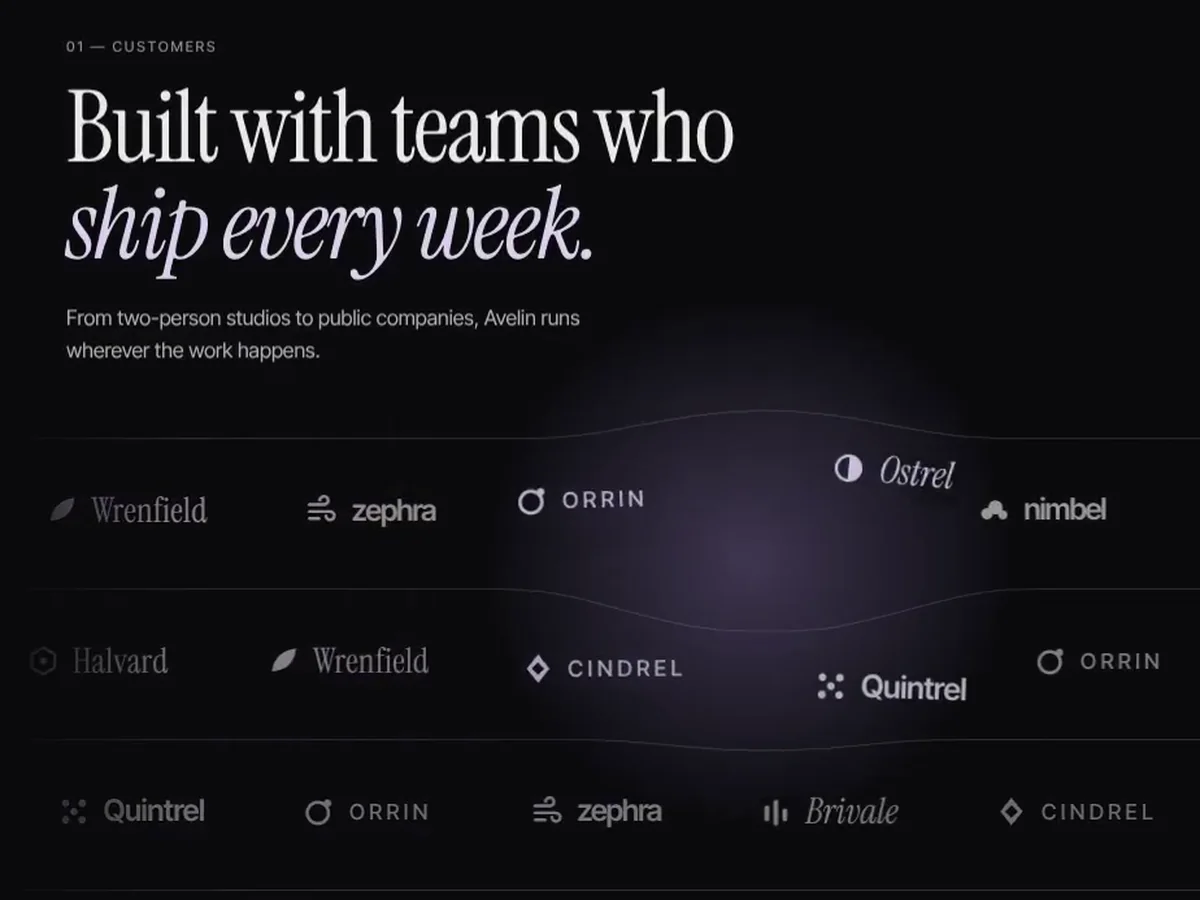
Rows of invented client logos drift between fine field lines, bend away from your pointer and spring back into rhythm.